What Is an Invoice? Definition, Parts & Example
Luki
An invoice is a dated document a seller sends to a buyer to request payment for goods or services already delivered or agreed. It lists the seller and buyer, a unique invoice number, what was supplied, quantities and prices, any tax, the total due, and when and how to pay. It is also both sides’ record of the sale.
That is the short answer. The rest of this guide covers what each part of an invoice is for, how an invoice differs from the documents it gets confused with, what the law asks for in a few major places, and a complete worked example with the math shown.
I build Invoiceize, a free invoice generator, so I spend a lot of time looking at invoices that did and did not get paid on time. Most of what follows comes from that: the invoices that get paid fastest are the ones that answer every question a client’s accounts team might have before they ask it.
What does an invoice do?
An invoice has three jobs, and it helps to keep them separate:
- It asks for money. It tells the client exactly how much to pay, by when and where to send it. A vague invoice (“design work, $2,000”) invites questions, and questions delay payment.
- It records a sale. For the seller, issued invoices are the evidence of income. For the buyer, received invoices are the evidence of an expense. Both sides keep a copy for their books and for tax.
- It sets the terms. Due date, late fees, accepted payment methods and deposits already paid all live on the invoice. If there is ever a dispute, the invoice is usually the first document anyone looks at.
An invoice is not a contract on its own. The agreement to do the work comes first (a signed quote, an email, a contract), and the invoice bills against it.
What is on an invoice?
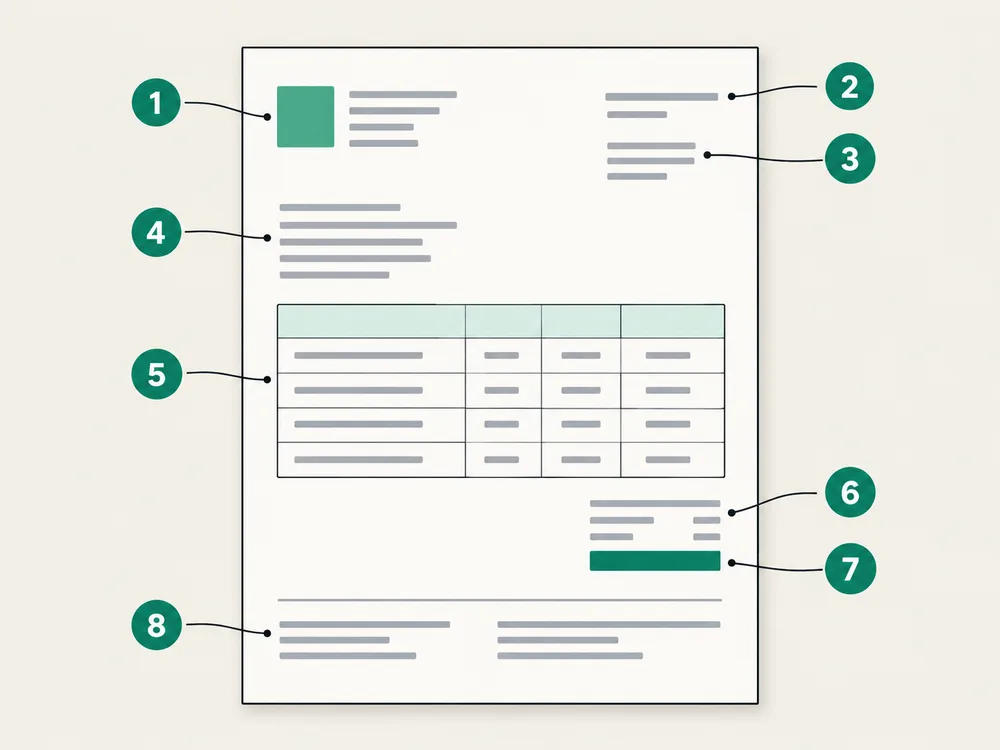
Almost every professional invoice, in any country, has these eight parts. The numbers match the diagram above.
- Your business details. Your name or business name, address and contact email. Add your logo if you have one. If you are registered for sales tax or VAT, your tax number usually goes here too.
- Invoice number. A unique reference that no other invoice from your business uses. More on this below.
- Dates. The invoice date (when you issue it) and the due date (when payment is expected). Many invoices also show the date the work was done or the goods were delivered.
- Bill to. The client’s name or company name, address and, for business clients, the person or department that handles invoices.
- Line items. One line per thing you are charging for: a clear description, a quantity (hours, units, days), a unit price and the line amount.
- Subtotal, discount and tax. The sum of the lines, any discount, and each tax as a separate line with its rate.
- Total due. The final amount, in a stated currency. If the client has already paid a deposit, show it and the remaining balance due.
- Payment details and terms. How to pay (bank transfer details, PayPal, card link), payment terms such as “Net 30”, and any late-payment policy.
Optional but useful: a purchase order (PO) number if the client gave you one, a short thank-you note, and your registration number if you are a company in a country that requires it on business documents.
What is an invoice number?
An invoice number is a unique identifier for each invoice you issue. It lets you and your client refer to one specific bill (“I’m chasing INV-0042”), and it lets an accountant or tax inspector check that no invoices are missing from your records.
The simplest scheme is a sequence: INV-0001, INV-0002, INV-0003. Some businesses add the year (2026-001) or a client code (ACME-014). Whatever you choose, keep it unique and in order, and never reuse a number, even for an invoice you cancelled. Cancel it with a credit note instead. The companion guide on how to make an invoice goes deeper on numbering schemes.
What is a PO number on an invoice?
A PO (purchase order) number is the buyer’s internal reference for the purchase. Larger companies often cannot pay an invoice unless it quotes the PO number their procurement team issued. If a client sends you one, put it on the invoice. If they did not, you can leave the field off.
Invoice vs receipt vs quote vs bill vs purchase order
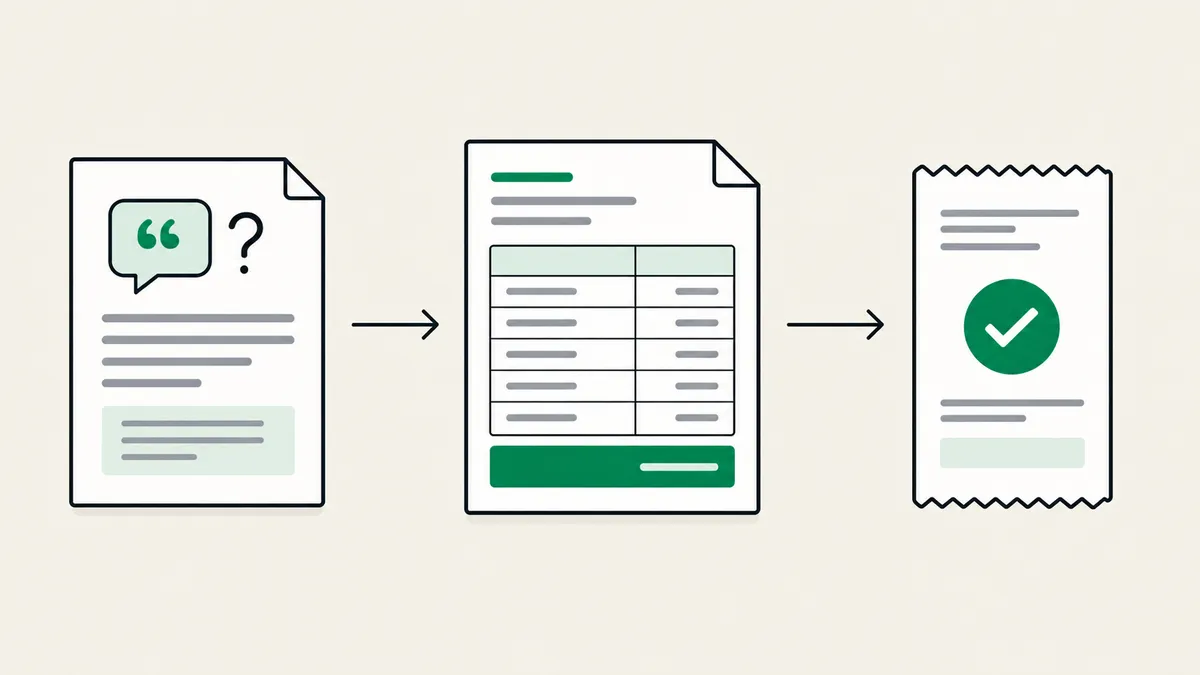
These documents describe the same sale at different moments. The simplest way to tell them apart is to ask who sends it and when.
| Document | Who sends it | When | What it says |
|---|---|---|---|
| Quote / estimate | Seller | Before any work | “This is what it would cost.” Not a request for payment |
| Purchase order | Buyer | Before any work | “We agree to buy this, at this price.” The buyer’s commitment |
| Invoice | Seller | After delivery (or at an agreed milestone) | “Please pay this amount by this date.” |
| Bill | (Buyer’s view) | When an invoice arrives | Same document as the invoice, seen from the paying side |
| Receipt | Seller | After payment | “We received your payment.” Proof the money arrived |
| Statement | Seller | Periodically | A summary of all invoices and payments on an account |
A few distinctions trip people up:
- Invoice vs receipt. An invoice asks for money that has not yet been paid. A receipt confirms money that has. Send the invoice first; issue the receipt after the client pays. If you need one, the receipt generator makes it from the same details.
- Invoice vs quote. A quote is an offer, and the client can say no. An invoice bills for something already agreed. Many freelancers send a quote first and turn it into an invoice when the job is done.
- Invoice vs bill. In everyday use they are the same piece of paper. Accountants call it an invoice when you send it (accounts receivable) and a bill when you receive it (accounts payable).
What are the common types of invoices?
The format barely changes between types. What changes is when you send it and what the lines represent.
- Standard invoice. One-off work or a sale, billed after delivery.
- Hourly or timesheet invoice. Lines are hours worked at a rate, often grouped by day or week. See the hourly invoice template.
- Progress or milestone invoice. A long project billed in stages, such as 30% at kickoff, 40% at design approval, 30% on launch.
- Deposit or advance invoice. Asks for part of the price before work begins. The final invoice then shows the deposit as already paid.
- Recurring invoice. The same amount every month for a retainer or subscription.
- Credit note. Not really an invoice but its opposite: it reduces or cancels an invoice you already issued, without deleting it from your records.
- Pro forma invoice. A preliminary invoice sent before delivery so the buyer can arrange payment, customs or approvals. It is not a demand for payment and usually is not recorded as a sale.
- Commercial invoice. Used in international shipping. Customs uses it to assess duties, so it adds details like country of origin and product codes.
- E-invoice. A structured, machine-readable invoice (XML or similar) exchanged between systems. A PDF sent by email is an electronic document, but in the legal sense many countries do not count it as an e-invoice.
What does the law say an invoice must include?
This depends on where you are and whether you charge sales tax or VAT. There is no single global rule, so check your own country’s tax authority. Some representative examples, all from official sources:
United States. There is no federal list of required invoice fields for general business. What matters is that your records support the income and expenses on your tax return. Sales tax rules, including what must appear on an invoice, are set by each state. For how long to keep invoices, the IRS says to keep records for 3 years in most cases, and longer in specific situations. For example, it says 7 years if you claim a deduction for bad debt, 6 years if you underreported income by more than 25%, and 4 years for employment tax records.
United Kingdom. GOV.UK lists what an invoice must include: a unique identification number, your business name, address and contact information, the customer’s name and address, a clear description of what you are charging for, the date of supply and the invoice date, the amount being charged, VAT if applicable, and the total owed. Limited companies must use the full registered company name. If both you and your customer are VAT registered, you must issue a VAT invoice, which requires more detail. On late payment, UK law says that if no payment date was agreed, a business payment is late 30 days after the customer receives the invoice or the goods or services, whichever is later.
European Union. For VAT purposes, the European Commission’s invoicing rules require a full VAT invoice to show the date of issue, a unique sequential number, the supplier’s and customer’s full names and addresses, the customer’s VAT number where the customer is liable for the tax, a description and quantity of the goods or services, the unit price excluding tax, and the VAT rate and amount, broken down by rate. EU countries can add national rules on top, and several now require structured e-invoices for some or all business sales.
The practical takeaway: an invoice that includes all eight parts from the list above, plus your tax number and the tax breakdown where you are registered, covers the core requirements in most places. If you are VAT or GST registered, check the exact wording your tax authority wants.
Worked example: a complete invoice
Here is a realistic invoice from a freelance web designer. Every number is calculated, so you can check the math.
- From: Alder Studio, 12 Pine Street, Portland, OR 97204, [email protected]
- Bill to: Harbor & Hops Brewing, Accounts Payable, 90 Dock Road, Portland, OR 97209
- Invoice #: INV-0042
- Invoice date: September 26, 2026
- Due date: October 26, 2026 (Net 30)
- PO #: HH-7731
| Description | Qty | Rate | Amount |
|---|---|---|---|
| Website design, 5 pages | 1 | $2,400.00 | $2,400.00 |
| Copywriting (hours) | 6 | $75.00 | $450.00 |
| Stock photo licenses | 3 | $20.00 | $60.00 |
| Subtotal | $2,910.00 | ||
| Tax (7%) | $203.70 | ||
| Total | $3,113.70 | ||
| Deposit paid (Sept 1) | −$1,000.00 | ||
| Balance due | $2,113.70 |
- Payment: ACH transfer to Alder Studio (bank details printed on the invoice) or card via the payment link in the email
- Terms: Net 30
- Note: Thank you for the project
How the numbers work:
- Line amounts are quantity times rate: 6 × $75.00 = $450.00, and 3 × $20.00 = $60.00.
- Subtotal: $2,400.00 + $450.00 + $60.00 = $2,910.00.
- Tax: 7% of $2,910.00 = $203.70. The 7% is only an illustration. Whether you charge sales tax on services, and at what rate, depends on your state and what you sell.
- Total: $2,910.00 + $203.70 = $3,113.70.
- Balance due: $3,113.70 − $1,000.00 deposit = $2,113.70. Showing the deposit avoids the classic mistake of a client paying the full total twice.
You can build this exact invoice in the free invoice generator: the subtotal, tax, deposit and balance are calculated as you type. If your work is billed differently, start from a template for freelancers, contractors (labor and materials as separate lines), consulting or a blank invoice.
Invoice checklist before you hit send
Run through this list for every invoice. It takes thirty seconds and catches most of the reasons invoices get sent back.
- Invoice number is new and follows your sequence
- Invoice date and due date are both there, and the due date matches your agreed terms
- Client’s legal or company name is spelled correctly, and the right person or department is named
- PO number is included if the client issued one
- Each line says what it is, with a quantity and a rate someone outside the project would understand
- Discounts and each tax are shown as separate lines, with the rate
- Deposits or earlier payments are subtracted, and the balance due is clear
- Currency is stated (especially for international clients)
- Payment details are complete and correct: bank details, PayPal address or a payment link
- Your tax or VAT number is included if you are registered
- Saved as a PDF so the layout cannot shift or be edited by accident
Frequently asked questions
Is an invoice the same as a bill?
Yes, in practice. It is the same document viewed from opposite sides: the seller issues an invoice, and the buyer receives and pays a bill. Accounting software keeps them in different places, accounts receivable for invoices you send and accounts payable for bills you receive.
Is an invoice a legally binding document?
An invoice records a debt and the terms of payment, and it is strong evidence in a dispute. But the obligation to pay usually comes from the underlying agreement, such as the contract, accepted quote or purchase order. The invoice bills against that agreement rather than creating it.
Is an invoice proof of payment?
No. An invoice shows that payment was requested. Proof of payment is a receipt, a bank statement entry, or an invoice marked “Paid” with the payment date and method.
When should I send an invoice?
Send it as soon as the work is delivered or a billing milestone is reached, while the value of the work is fresh. For ongoing work, bill on a fixed schedule, for example on the first of each month. Delays in invoicing turn directly into delays in getting paid.
What does “Net 30” mean on an invoice?
Net 30 means the full amount is due 30 days after the invoice date. Net 15 and Net 60 work the same way. “Due on receipt” means payment is expected immediately. Terms like “2/10 Net 30” offer a 2% discount if the client pays within 10 days.
How long should I keep invoices?
It depends on your country. In the US, the IRS generally says 3 years, with longer periods in specific cases such as 7 years for bad-debt deductions. Other countries set their own periods, and five to ten years is common. Keeping digital copies of every invoice you send and receive, organized by year, covers most situations.
Can I make an invoice without accounting software?
Yes. A word processor, a spreadsheet or a free online invoice generator all work, as long as the invoice contains the required details and you keep copies. The step-by-step guide on how to make an invoice compares these options honestly.
Ready to send your invoice?
Fill it in, download a PDF with no watermark. No signup needed.
Open the invoice generator